Your situation

Sell land with back taxes owed.

Delinquent taxes do not stop a sale and do not have to come out of your pocket first. What matters is how far along the county's process has already gone.

The county gets paid at closing, not by you

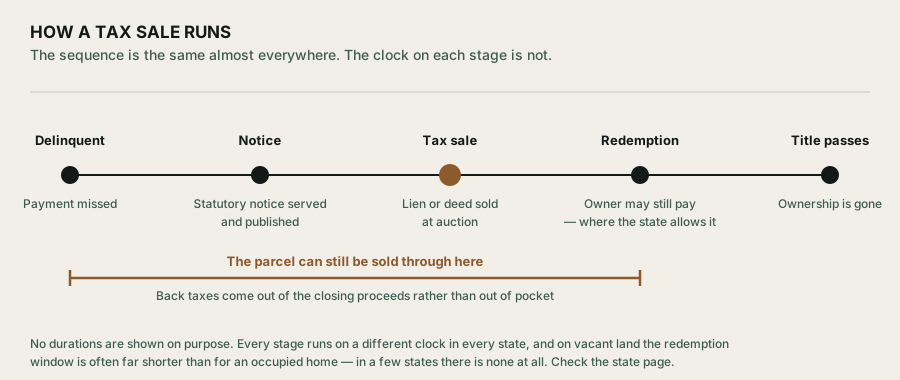
Delinquent property taxes are a lien against the parcel, and liens are settled out of the proceeds at closing before anything is distributed to you. This is routine — the title company calculates the payoff, pays the county, and disburses the balance. You do not need to find the money in advance, and being behind does not make the parcel unsellable.

Where you are in the timeline is the real question

Every state runs its own clock, and the difference between year one and year four of delinquency is enormous. Broadly, counties assess and notice, then either sell a tax lien to an investor or move toward selling the deed itself, with a redemption period in between during which you can still pay and keep the property. Redemption periods vary widely by state — some are measured in months, others in years. Once redemption expires, the property is gone and so is any equity in it. The date on your notice is the single most useful thing you can tell us.

Tax lien states and tax deed states behave differently

In tax lien states the county sells a certificate to an investor who pays your taxes and earns interest, and who can eventually foreclose if you never redeem. In tax deed states the county eventually sells the property itself. In lien states there is usually more time and a clearer payoff figure. In deed states the sale date is a hard deadline. Either way, selling before that date typically returns you far more than letting the process run, because a tax sale is designed to recover the taxes owed, not to return your equity.

A sale can still close inside a short window

Where a sale date is close, the constraint is title work rather than willingness. A clean parcel with one owner can move quickly. Probate that has not closed, heirs who need to be located, or an old unreleased mortgage all take time we may not have. We would rather tell you plainly at the outset that a deadline is not achievable than start a process that fails and leaves you worse off.

Surplus after a tax sale, if it has already happened

If the property has already sold at a tax sale for more than was owed, the difference is often claimable by the former owner. Many states hold these surplus funds for a period, and a large number go unclaimed because owners never learn they exist. Deadlines and procedures vary considerably by state. If your parcel has already been sold, this is worth investigating rather than assuming nothing remains.
Valuation

What moves the number

What we look at on a tax-delinquent parcel, beyond the ordinary land factors.

Factor Effect on value
Total payoff including interest, penalties, and fees Deducted from proceeds. Interest and penalties can approach the tax itself.
Redemption deadline or scheduled sale date Determines whether a transaction is feasible at all.
Whether a lien certificate has already been sold Adds a third-party interest holder and a separate payoff calculation.
Other liens recorded against the parcel Judgments, mortgages, and municipal liens all settle from the same proceeds.
Title condition and how fast it can be cleared The binding constraint when a deadline is close.
Underlying land value Still the basis of the offer. Delinquency reduces net, not the land's worth.

Questions

Selling land with back taxes

Do I have to pay off the back taxes before I can sell?

No. Delinquent taxes are paid to the county from the closing proceeds, before anything is distributed to you, and the remainder is yours. You do not need to find the money first. This is one of the most common misconceptions we encounter, and it stops people from acting while they still have time.

My land is scheduled for a tax sale. Is it too late?

Not necessarily, but the date is the deciding factor and you should tell us immediately. Before a sale, you generally retain the right to redeem, and selling usually returns far more than letting the sale proceed — a tax sale is structured to recover what is owed, not to protect your equity. Whether we can close in time depends mostly on how quickly title can be cleared.

How much do I actually owe?

More than the tax figure alone, typically. The payoff includes accrued interest, penalties, and administrative fees, and in some states those additions approach the size of the original tax. The county treasurer can give you an exact payoff good through a specific date, and the title company will order one as part of closing.

My property already sold at a tax sale. Is there anything left for me?

Possibly. If the property sold for more than was owed, many states hold the surplus for the former owner to claim, and a great deal of it goes unclaimed simply because people do not know it exists. Deadlines and procedures differ by state and some are short, so it is worth checking with the county rather than assuming the equity is gone.

Get an offer

Tell us about the parcel

State, county, and parcel number is enough to start. We reply within one business day.

No listing agreement and no obligation. We reply within one business day.